
Washington employers have spent the last several years adjusting to the state’s pay transparency requirements under the Equal Pay and Opportunities Act (EPOA) and responding to a growing number of lawsuits alleging noncompliant job postings.
Much of the litigation to date has focused on threshold questions: Who can sue? What constitutes a covered job posting? And what information must employers include in their postings? In Branson v. Washington Fine Wine & Spirits, for example, the Washington Supreme Court held that a person who applies to a specific job posting need not prove a bona fide or good-faith intent to accept the job to qualify as an “applicant” under the EPOA.
The Washington Legislature significantly changed the landscape in July 2025 by revising the remedies available for pay-transparency violations. Among other changes, the Legislature replaced the prior fixed $5,000 statutory-damages framework with one authorizing courts to award between $100 and $5,000 per violation and created a temporary cure process for certain posting deficiencies.
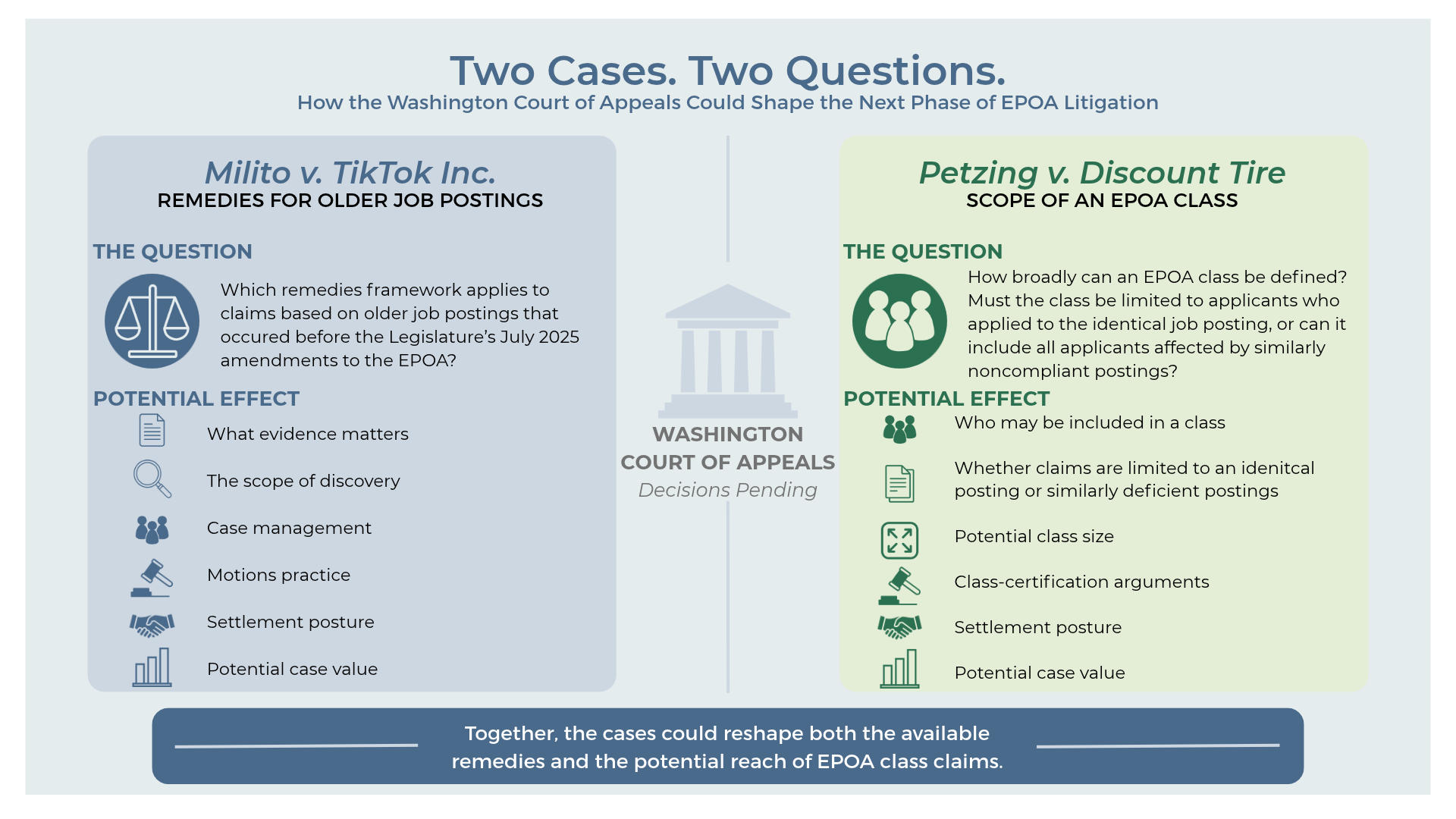
Two questions will shape the next phase of EPOA litigation: which remedies apply to claims based on older job postings, and how broadly an EPOA class may be defined.
The Remedies Question in Milito
The first question is already before the Washington Court of Appeals in Milito v. TikTok Inc.[1] What remedies are available for alleged pay-transparency violations that occurred before the Legislature amended the EPOA in July 2025?
The Washington Court of Appeals recently granted discretionary review of that issue, recognizing that it presents a controlling question of law that could materially affect numerous pending EPOA cases. In the meantime, courts are staying parallel cases while awaiting appellate guidance.
The significance of Milito extends beyond the remedies potentially available to individual plaintiffs. The decision could affect how pending cases are litigated more broadly, including what evidence matters, the appropriate scope of discovery, and how parties approach dispositive motions, class certification, and settlement.
Why Courts Are Staying Parallel Cases
The reason is practical: many EPOA complaints involve the same plaintiff, similar allegations, and the same theory of liability based on allegedly deficient job postings. One federal court noted that a single plaintiff had reportedly filed more than 50 similar EPOA actions in King County Superior Court.
Proceeding through discovery, dispositive motions, or class certification while the Milito appeal remains pending could therefore impose substantial costs under a remedies framework that the Court of Appeals may ultimately determine does not apply.
A stay is procedural, not substantive. It does not mean that the underlying claims lack merit; it simply pauses the litigation until the appellate court provides guidance on an issue that may materially affect how those claims proceed.
The Class-Scope Question in Petzing
A second issue may soon reach the Court of Appeals: how broadly may an EPOA class be defined?
In Petzing v. Discount Tire, the trial court limited a proposed class to applicants who applied to the identical job posting as the named plaintiff, rather than extending the class to applicants who responded to other allegedly noncompliant postings.[2] The plaintiff has sought discretionary review of that ruling with the Washington Court of Appeals, Division One.
If review is granted, Petzing could provide important guidance on the permissible scope of EPOA class actions. A decision on that issue could have significant implications for the size of putative classes and, in turn, the potential exposure associated with pending and future EPOA litigation.
As of this writing, the Court of Appeals has not yet decided whether to accept review. On October 7, 2026, the court set the motion for consideration without oral argument on its February 26, 2027 calendar, and confirmed that the trial court retains full authority to proceed with the underlying case in the meantime.[3]
What the Decisions Could Mean for Pending Litigation
Taken together, Milito and Petzing could clarify two issues central to the future of EPOA litigation: the remedies available for alleged violations and the potential reach of class claims.
Milito will address which remedies framework applies to claims arising from older job postings, a question that could substantially affect the value and trajectory of pending cases. Parties involved in EPOA litigation should therefore reassess their strategies after the Court of Appeals issues its decision, including their approach to motions practice, class certification, settlement, and early resolution.
If the Court of Appeals accepts review in Petzing,that case could provide complementary guidance on how broadly an EPOA class may be defined.
Together, the two cases could shape both the potential value and potential scope of Washington pay-transparency litigation going forward.
For practical guidance: Read A Stay Is Not a Safe Harbor: What Washington Employers Should Know While Courts Await the Milito Decision for steps employers can take while the litigation remains pending.
[1] The appeal currently pending before the Washington Court of Appeals, Division One, stems from two related cases, Milito v. ByteDance Inc. and Milito v. TikTok Inc.., which the court consolidated for review under Milito v. TikTok Inc., COA No. 89079-4.
[2] No. 24-2-25791-8 SEA (Wash. Super. Ct. King County May 11, 2026).
[3] Petzing v. Discount Tire Co. of Wash., No. 898272 (Wash. Ct. App. Div. I Oct. 7, 2026) (Rogers, Comm’r) (notation ruling setting motion for discretionary review for consideration without oral argument)